Andy Burnham says he wants to deliver the greatest transfer of power away from Westminster that England has ever seen.
Devolving power away from an overcentralised British Government is a legitimate and necessary objective.
However, Burnham’s approach contains a fundamental constitutional flaw.
He proposes transferring substantial powers directly from Westminster to regional mayors and strategic authorities without first establishing a government for England.
That is not genuine English devolution. It is the regionalisation of England, and it will ultimately break England apart.
Burnham’s government proposes giving regional mayors greater control over housing, planning, transport, employment, skills, energy and economic development. Plans have also been announced to allow mayors to retain a share of locally generated taxation.
These changes are presented as bringing government closer to the people. In reality, they will divide England into a patchwork of powerful administrative regions while Scotland, Wales and Northern Ireland continue to be recognised through their own national political institutions.
Scotland has its Parliament and its own government. Wales has its Senedd and its own government. Northern Ireland has its Assembly and its own government. England, the largest nation of the United Kingdom, is instead being offered regional mayors.
The 1st question that Andy Burnham needs to be asked is: -
Why is England the only nation that must be divided before it can receive devolved power?
Devolution Must Come to England First
The Campaign for an English Parliament supports the devolution of power. However, devolution must be introduced through a clear, democratic and constitutionally balanced structure.
The first stage must be the establishment of an English Parliament and government, with responsibility for England’s domestic affairs. Powers could then be devolved from that Parliament to England’s historic counties, local authorities and communities.
The structure would be straightforward. Matters affecting the whole United Kingdom would remain with the UK Government and be legislated upon by the UK Parliament, while matters affecting England alone would be transferred to an English Government and Parliament. Local responsibilities would then be exercised through counties, councils and communities.
Burnham’s approach misses out the English national level completely. Power would pass directly from the British Government to constructed regional bodies, leaving England without any institution capable of speaking or governing on behalf of England as a whole.
This is devolution without a constitutional foundation.
An English Parliament would give England the same democratic recognition already afforded to the other nations of the United Kingdom. Regionalisation denies England that equality and substitutes administrative areas for national democracy.
This is obvious, so the 2nd question Andy Burnham needs to be asked is: -
Why is the English national level being completely ignored?
England’s Size Cannot Be Used Against her
One of the arguments repeatedly raised against an English Parliament / Government is that England would be too large and would dominate the United Kingdom.
England is undeniably the largest nation within the UK. But that is a geographical and democratic reality. It cannot be erased by drawing regional boundaries across the country.
Large nations coexist with smaller nations throughout Europe. Germany is larger than Denmark. France is larger than Belgium. Spain is larger than Portugal. Their different sizes do not require the larger countries to be dismantled or denied national institutions just because they're all are part of the EU.
If England’s size creates difficulties for the present structure of the United Kingdom, those difficulties should be addressed openly through a federal constitutional settlement. England should not be politically neutralised through regionalisation.
Breaking England into administrative territories is a backhanded attempt to manage the constitutional imbalance without acknowledging England as a nation.
It will not resolve the English Question. It will deepen it.
City Regions Will Dominate the Countryside
Burnham’s preferred model has grown out of his experience as Mayor of Greater Manchester. Yet what works within a large and closely connected metropolitan area cannot automatically be imposed upon the whole of England.
England is not one enormous city region.
Its historic counties contain cities, towns, villages, coastal communities and vast agricultural areas. Their needs and identities cannot simply be absorbed into mayoral territories organised around the largest urban centres.
Regional mayoral systems will inevitably be dominated by their biggest cities. Those cities may prioritise mass transport, high-density housing, major regeneration schemes and metropolitan economic development.
Rural communities may be more concerned about farming, food production, village infrastructure, flood prevention, country roads, local health provision and the survival of small towns.
When those interests conflict, political power will usually sit with the largest population centre.
The result will be city against countryside and metropolitan priorities against rural and agricultural needs.
Communities outside the dominant city may contribute to the regional authority while watching investment and political attention gravitate towards the urban centre.
This would not bring power closer to the people. It would merely transfer power from one remote centre to another.
Artificial Regions Will Weaken Historic England
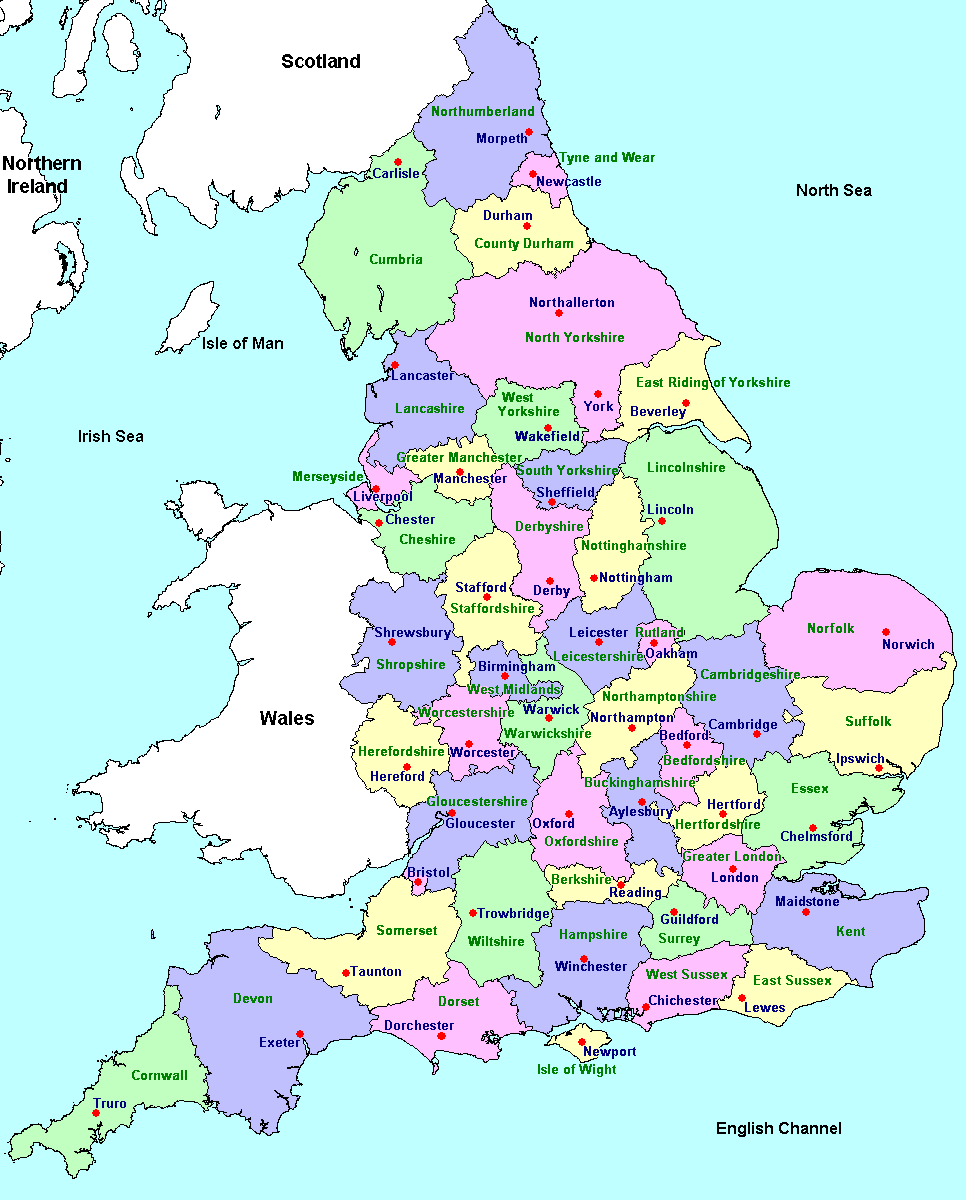
England’s historic counties have identities developed over centuries. Yorkshire, Lancashire, Suffolk, Essex, Kent, Devon, Cornwall and England’s other counties are not simply administrative conveniences. They represent geography, history, culture and belonging.
Many proposed strategic authorities, by contrast, are designed around administrative or economic calculations. Their boundaries may cross traditional counties, divide established communities or join together areas with very different interests.
As these new regions acquire planning powers, transport responsibilities, taxation arrangements and permanent bureaucracies, their administrative boundaries could gradually become political dividing lines.
Farms, businesses and communities close to those boundaries may find themselves subject to different policies despite sharing the same historic county, landscape and local economy.
Once political institutions possess money, taxation powers and bureaucracies, they begin defending and expanding their own authority. Regions created for administrative convenience can develop competing interests and identities.
England would cease to be governed as one nation and instead become a battleground between increasingly powerful regional administrations.
That is fragmentation, not devolution.
England Is a Nation, Not a Collection of Regions
Burnham is probably right that Westminster and Whitehall hold too much power.
But correctly identifying the problem does not make his solution safe.
England needs devolution, but it must be democratic, constitutionally coherent and rooted in England’s national identity. The Solution is actually quite simple!
The answer is an English Parliament / Government with powers comparable to those exercised in Scotland, Wales and Northern Ireland. That Parliament should then devolve meaningful powers to England’s historic counties, councils and local communities.
Counties could cooperate on transport, infrastructure, economic development and public services without surrendering their names, identities or democratic independence to artificial regional governments.
An English Parliament would also create a clearer and fairer United Kingdom. England would manage its domestic affairs while the UK Government concentrated on genuinely UK-wide responsibilities.
This would strengthen rather than weaken relationships between the nations. British identity would no longer depend upon England being denied the national democratic recognition granted to everyone else.
The 3rd and 4th questions that Andy Burnham needs to be asked are:-
Why won’t Andy Burnham give England the same respect and democratic recognition afforded to Scotland, Wales and Northern Ireland?
Why is he resisting the obvious solution, an English Parliament for the people of England?
Burnham’s present direction risks producing the opposite result to a stable England. It would construct powerful regional administrations, place cities above their surrounding countryside and leave England without a national democratic voice.
This is not merely administrative reorganisation. It is the fundamental restructuring of England without the clear consent of the English people.England does not need to be divided in order to be governed locally. It needs to be recognised nationally and empowered locally.
The correct order is clear:
(1) Establish an English Parliament and then (2) devolve power through that Parliament to England’s historic counties and communities.
Devolution must come to England before it is distributed within England. Anything else risks becoming the managed dismantling of the nation.
Attempting this, would make Andy Burnham the most anti-English Prime Minister of all time, which is saying something after the Scottish, British Prime Minister, Gordon Brown.
Brown repeatedly spoke in terms of “the nations and regions of the UK”, recognising Scotland, Wales and Northern Ireland as nations while reducing England to a collection of regions. It was an approach that refused to recognise England’s right to exist politically as one nation.
Burnham is now following the same anti-English constitutional path. Put bluntly, he is “brown-nosing Brown”: *adopting Gordon Brown’s political language and regionalist approach while denying England the national recognition given to Scotland, Wales and Northern Ireland. The phrase may be humorous, but the constitutional consequences are anything but.
Stephen Davis
Chairman
Campaign for an English Parliament
* “Brown-nosing” means flattering or closely following someone to gain favour.
Key Takeaways
- Critique of Regional Devolution: Transferring power to regional mayors bypasses an English national government, fracturing England's constitutional identity.
- Demands for National Parity: England remains the only UK nation without its own parliament or assembly, unlike Scotland, Wales, and Northern Ireland.
- City vs. Countryside Imbalance: Mayoral regional models risk prioritizing major urban centers over rural, agricultural, and historic county interests.
- Two-Stage Devolution Proposal: Advocates establishing an English Parliament first before delegating local powers to historic counties and communities.