Contrary to popular misconception, the Battle of the Boyne (Ireland) never took place on July 12th, 1690. It was initially scheduled for the 11th of that month due to the Gregorian Calendar shift, and then a day later, under pressure from the Orange Order, to coincide with another battle in County Galway that took place over a year later.
As such, this date has been wrongly attributed to a battle that was never fought, overshadowing a real historic achievement that our people should find most relevant.
King Athelstan and the Unification of England
King Athelstan, who reigned from 924 to 939 AD, was one of the most significant yet often underappreciated figures in English history. As the grandson of Alfred the Great and the son of King Edward the Elder, Athelstan inherited a growing but still fragile Anglo-Saxon kingdom. Through military brilliance, political strategy, and legal reform, he became the first true King of a unified England within its national borders, laying the foundations for the English nation-state.
Early Life and Rise to Power
Athelstan was born around 894 AD, the eldest son of Edward the Elder and his first wife/ mistress. Ecgwynn. Raised at the court of his grandfather, Alfred the Great, Athelstan received a thorough education in warfare, leadership, and piety — all of which would define his later reign. According to the chronicler William of Malmesbury, Alfred recognised Athelstan's greatness early on, reportedly giving him a ceremonial cloak, belt, and sword when he was still a child.
On the death of King Alfred and the succession of his father Edward to the thrown of Wessex, Athelstan was taken to Mercia to be raised by his aunt Ethelflaed, the Lady of the Mercians. A move which some scholars believe indicates that Athelstan’s mother was a mistress, not a wife, and therefore he was illegitimate, which necessitated his removal from court so as not to embarrass King Edward's new Queen.
When Edward the Elder died in 924, Athelstan was quickly recognised as king by the Mercians, but not immediately accepted in Wessex, probably because of his illegitimacy, where support went to his half-brother Ælfweard. Ælfweard’s sudden death only sixteen days later cleared the path for Athelstan to be crowned King of the Anglo-Saxons on 4th September 925, at Kingston upon Thames — a symbolic border between Wessex and Mercia, representing his authority over both.
Unifying the Kingdom
Athelstan inherited a realm that had already expanded under his grandfather Alfred, is father Edward, and his Aunt Ethelfled in one of the most brilliant campaigns in early English history, but it was still politically fragmented. The Danelaw, which included East Anglia, and large areas of the East Midlands and the North, was ruled by Scandinavian settlers and remained semi-autonomous. Athelstan’s aim was nothing less than to bring these territories into a single, unified English kingdom.
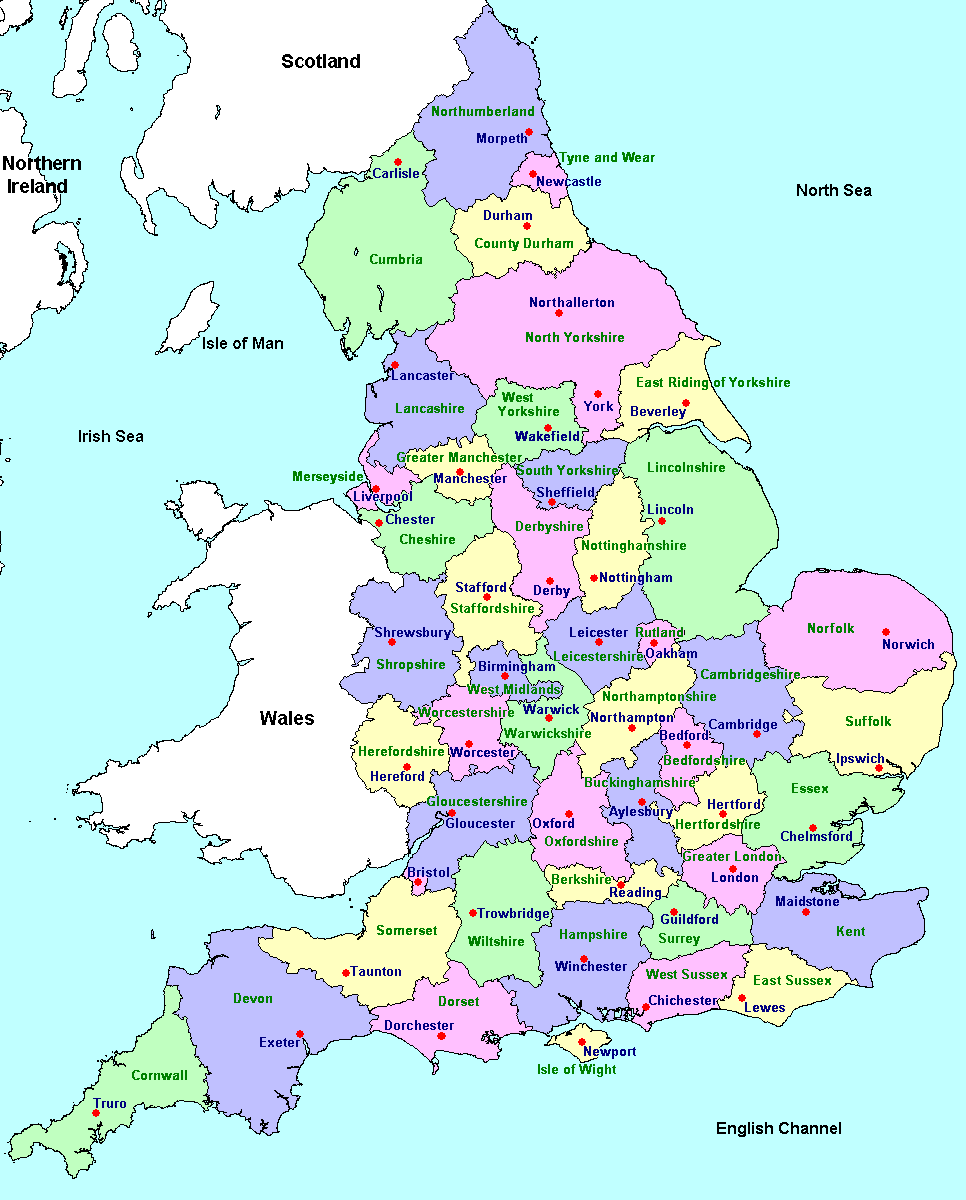
His breakthrough came in 927, when he captured York and forced the submission of King Guthfrith of Northumbria. This was a turning point: and at Eamony near Penrith in Cumbria on the 12th of July all of the Anglo-Saxon and Viking kingdoms of England came under the authority of one ruler and thus England was unified and its borders set, which have roughly lasted to the present day.
Athelstan then summoned the Norse and Celtic kings of Scotland, Strathclyde, and Wales to acknowledge him as overlord, which they all did. There were rebellions to his rule, which the Celts saw as overbearing. The most notable being that of King Constantine of Scotland in 93,4 which Athelstan crushed in a lightning campaign by land and sea.
The Battle of Brunanburh
The most famous event of Athelstan’s reign, however, came in 937, with the Battle of Brunanburh. Following his humiliation, Constantine of Scotland plotted revenge and organised a powerful coalition of enemies, which included Owain of Strathclyde, and Olaf Guthfrithson, the Norse-Gael king of Dublin, who willingly joined forces to challenge Athelstan's rule. They launched an invasion aimed at breaking the new English unity.
Athelstan, alongside his half-brother Edmund, met the invaders in a decisive and brutal battle which lasted all day. The Anglo-Saxon Chronicle describes it in epic terms, portraying it as the battle that secured the English nation. Athelstan’s victory was complete, with many enemy leaders killed or driven out. This triumph not only reaffirmed his control over England but also ended major external threats to his rule. Though the exact location of Brunanburh is still debated, the battle itself marked a defining moment in English history — a confirmation that England, as the unified kingdom of the Anglo-Saxons, had arrived.
Law and Governance
Athelstan was not only a warrior king but also a thoughtful lawgiver and statesman. He issued a series of law codes aimed at ensuring justice, curbing corruption, and promoting Christian morality. These laws addressed a wide range of issues, including theft, land disputes, the treatment of foreigners, and the support of the poor.
His legal reforms reflect an early attempt to centralise authority and standardise governance across the newly unified kingdom. He strengthened the role of royal officials, or reeves, in local justice, and promoted fairness in the treatment of both Anglo-Saxon and Danish subjects. Athelstan also supported the Church, seeing it as a partner in the creation of a morally guided and stable society. He brought in scholars from abroad, supported monastic reform, and encouraged the spread of learning and literacy.
Diplomacy and International Prestige
Athelstan’s court became one of the most prestigious in Europe during his reign. He arranged diplomatic marriages for his sisters into royal families across the continent — including the Holy Roman Empire, France, and Burgundy — cementing England’s position as a respected Christian kingdom.
Foreign leaders admired and feared him. The gifts, letters, and visits from rulers such as Hugh of Arles (King of Italy) and Otto I of Germany show the extent of Athelstan’s diplomatic reach. He was not merely a regional king, but a major European statesman. The respect Athelstan commanded abroad was also a reflection of the internal stability and unity he achieved at home.
Death and Legacy
King Athelstan died in 939 at the age of approximately 45, without leaving any children. He was buried at Malmesbury Abbey, a place he had generously supported.
Despite his achievements, Athelstan was somewhat overshadowed by the legends of Alfred the Great. Yet modern historians have increasingly recognised him as one of the most important monarchs in English history — the man who turned a patchwork of warring kingdoms into a single nation.
Athelstan’s legacy is evident in the structure of England itself. He united people of different ethnic backgrounds, including Celts, Anglo-Saxons, and the Danes, under one crown, and established institutions that outlasted him. His emphasis on law, royal authority, and national unity set precedents that shaped the English monarchy for centuries.
Conclusion
King Athelstan’s reign was brief but transformative. He achieved what no king before him had: the unification of England under one crown, with recognised borders and a central authority. Through military strength, wise governance, and international diplomacy, Athelstan built on the work of his Grandfather, Father, and Aunt to forge the English nation and secure its place on the European stage. Though history may not have always given him the spotlight he deserves, his impact on the development of England was foundational and enduring.
In every meaningful sense, Athelstan was England’s first true king — not just of a people or a dynasty, but of a united realm.
It's time we acknowledge the importance of Athelstan, and, perhaps like his grandfather, we should award him the epithet ‘The Great’ and make the 12th of July a national holiday, England Day. So, please sign our petition.